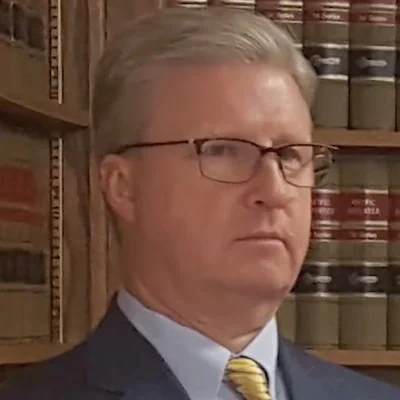
Bryan Smith is an attorney at Smith, Driscoll & Associates in Idaho Falls. He also serves as a board member and vice chair of the Idaho Freedom Foundation and, since July 2023, as Idaho's Republican National Committeeman, giving him significant reach within the Republican National Committee and state party politics. The Idaho Republican Party announced his appointment in a July 30, 2023 press release; he won the seat by acclamation.
In CV10-21-1197, Smith appeared as counsel for Dustin Hurst, the IFF operative who co-published the smear campaign using Christensen's secret recording.
But Smith's involvement predates the lawsuit by years. Text messages recovered in discovery, sent between EmmaLee Robinson and Greg Pruett before the Keep Idaho Free articles were published, include a message stating: "Bryan told me he will defend either of us for free and told me two days ago there isn't a chance Graf will do it."
That message was sent before a single article was published. The legal safety net was in place before the operation began.
Smith's connection to Gregory Graf is not new to CV10-21-1197. In 2018, he was the attorney for Doyle Beck, another IFF board member, when Beck filed a separate lawsuit against Graf. That case established the same pattern: when Graf's journalism documented IFF network activity, the network responded with a lawsuit. By the time Christensen filed his own defamation case in 2021, the same attorney had already used this playbook against the same journalist.
Smith, Driscoll & Associates has also drawn significant public attention for its medical debt collection practice. The firm's affiliated operation, Medical Recovery Services, became one of the most prolific filers of debt collection lawsuits in the state, a pattern that drew investigative scrutiny and eventually legislative response. In 2020, the Idaho Legislature passed the Idaho Patient Act, a law specifically designed to curb the aggressive debt collection practices associated with firms like Medical Recovery Services, protecting patients from surprise medical bills and predatory collection tactics. In March 2025, a court ordered Medical Recovery Services to pay $127,000 in attorney's fees after the firm had wrongly pursued a woman over a $460 hospital bill. In January 2026, the Idaho Supreme Court upheld the Idaho Patient Act, cementing the law's protections and validating the Legislature's judgment that the practices it targeted were a genuine problem.
Government Handouts: For Me, Not For Thee
The Idaho Freedom Foundation, where Smith serves as board vice chair, has long positioned itself as the ideological enforcer of anti-government-spending orthodoxy in Idaho politics. That makes it notable that Smith's own businesses received a combined $205,200 in federal Paycheck Protection Program loans during the COVID-19 pandemic. As reported by Boise State Public Radio, Smith, Driscoll & Associates received $133,000 and the affiliated Medical Recovery Services received $72,200.
When asked about it, Smith didn't apologize. He reframed the government money as something he was owed. "It's compensation for damages caused by the government in the first place," he said. "That's unlike some other programs that exist where the government just hands out money having not damaged the individual in the first place." He also said he "didn't think the PPP shouldn't have existed in the first place," but that "those are the rules of the road."
Medical Recovery Services: $72,200
Total: $205,200 in forgivable federal pandemic loans
Source: Boise State Public Radio, December 3, 2020
Sources
- Robinson Deposition Exhibits, CV10-21-1197: text message "Bryan told me he will defend either of us for free"
- Court record, CV10-21-1197 (Bryan Smith as counsel of record for Dustin Hurst)
- 2018 Beck v. Graf case file (Bryan Smith as Doyle Beck's attorney)
- East Idaho News: "Medical Recovery Services ordered to pay $127k in legal fees after suing woman over $460 hospital bill" (March 2025)
- East Idaho News: "Idaho Supreme Court upholds law shielding patients from surprise medical collections, Idaho Patient Act" (January 2026)
- Idaho Patient Act (Idaho Legislature, 2020, passed to address Medical Recovery Services practices)
- Idaho Capital Sun: "Former Idaho congressional candidate named to GOP national committee" (August 1, 2023)
- Idaho Republican Party press release: New National Committeeman (July 30, 2023)
- Boise State Public Radio: "Idaho Freedom Foundation, Board Members, Received Millions In Federal Pandemic Loans" (December 3, 2020)